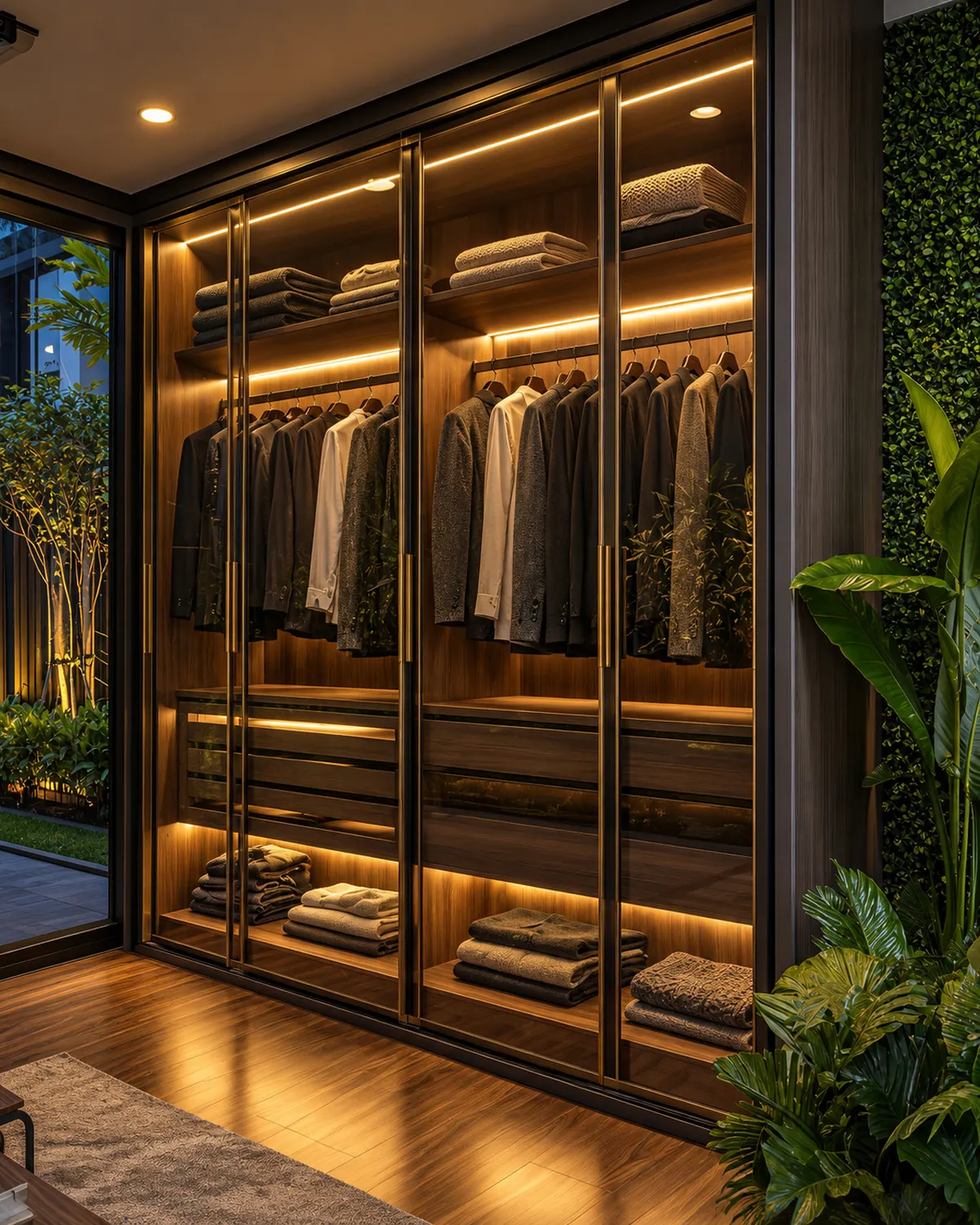
A new kitchen or wardrobe always looks good on handover day. The real test comes in year three, year five and year ten — after monsoons, daily cooking, children and a few house moves of furniture. Most of what decides that is invisible in a 3D view: the board inside, how the edges are sealed, and the hardware that carries the weight. Here is how we think about each layer.
1. The board comes first
Every carcass and shutter starts as a sheet of board, and it is the one thing you cannot change later. We choose it by where the unit will live:
- BWP (boiling-water-proof) plywood for kitchens, washrooms and anywhere water reaches. It holds screws and hinges well and does not swell easily when it gets wet.
- MR (moisture-resistant) plywood for dry areas such as bedrooms, study units and wardrobes, where it gives good strength at a lower cost.
- HDHMR board for shutters. It is dense and very flat, so doors stay straight and take laminate or acrylic cleanly.
- WPC or plywood backs on units that sit against walls, to keep damp walls from reaching the carcass.
Our packages name the board for each unit — for example Sainik MR plywood in Smart Essentials and Sainik 710 BWP plywood in the higher tiers — so you know exactly what you are paying for.
2. The finish: choose for daily life, not the catalogue
The finish is what you see and touch every day. Each has its place:
- Matte and textured laminates hide fingerprints and fine scratches, and are the most forgiving choice for busy kitchens and children's rooms.
- High-gloss laminates and acrylic give depth and reflection, but show fingerprints faster. We like them for wall units and feature shutters rather than every surface.
- PU paint gives seamless colour and soft edges. It needs a little more care and is best where you want a furniture-like look.
- Veneer brings real wood grain for statement pieces, and is usually kept to areas that are not exposed to water and heat.
A useful rule: pick your shutter colour last, after the flooring, wall colour and countertop are fixed. Very trend-driven colours date quickly; warm neutrals, woodgrains and soft greys tend to sit well for many years.
3. Edges are where furniture fails
Moisture almost always enters a board through an open edge. That is why every visible edge we cut gets edge banding, pressed by machine and trimmed clean, and shutters get a thicker band than inside panels. A unit can use the best board available and still fail early if its edges are left raw. When you compare quotations, ask how the edges are finished — it says a lot about the workshop.
4. Hardware carries the weight
Hinges open and close thousands of times; drawer channels carry pans, crockery and tins. We use named brands — EBCO, Hettich and Blum — chosen by package tier, with soft-close where it matters most. Good hardware also makes a unit easier to adjust years later, when doors need a small realignment.
5. Small habits that add years
- Wipe water off the sink-side shutters and the countertop edge rather than letting it dry there.
- Keep a small gap between appliances that give off heat and laminate surfaces.
- Do not overload a single shelf; spread heavy items across the unit.
- Ask for a hinge and channel adjustment after the first few months of use, once everything has settled.
Planning a kitchen, wardrobe or whole home?
See package prices in a few minutes, or talk to us about your space.